© 2025 Geni Kapo • All Rights Reserved • Designed by Gurgenius Kapoor
Da Vinci Surgical Systems
The Da Vinci Surgical System is a robotic platform that enhances minimally invasive surgery by translating a surgeon’s hand movements into precise instrument actions. It offers high-definition 3D vision, improved dexterity, and greater control for complex procedures. The system uses specialized tool drivers for suturing, cutting, grasping, and coagulation. This project aims to design a hemostatic powder dispensing tool compatible with these robotic arms.
Product study - Hemostatic Powder Dispenser
Hemostatic Powder Dispenser is a hemostatic agent whose flow-ability is influenced by factors like particle size, shape, moisture content, and cohesiveness. Environmental conditions such as temperature, humidity, and storage time further affect its dispensing behavior. Designing an effective delivery tool requires careful consideration of these properties to ensure consistent application.
Teardown of Hemostatic Powder Dispenser
Market Study
Various products were studied in order to gain inspiration and devise a mechanism able to dispense hemostatic powder using the rotating pegs of the adapter mounted on tool driver. Some products had similar mechanism but had a different application altogether.
Concept Direction Map
Based on the Use type and delivery mechanisms, some concepts were generated.
Device activated (Visual feedback: Green )
Device deactivated (Visual feedback: Red)
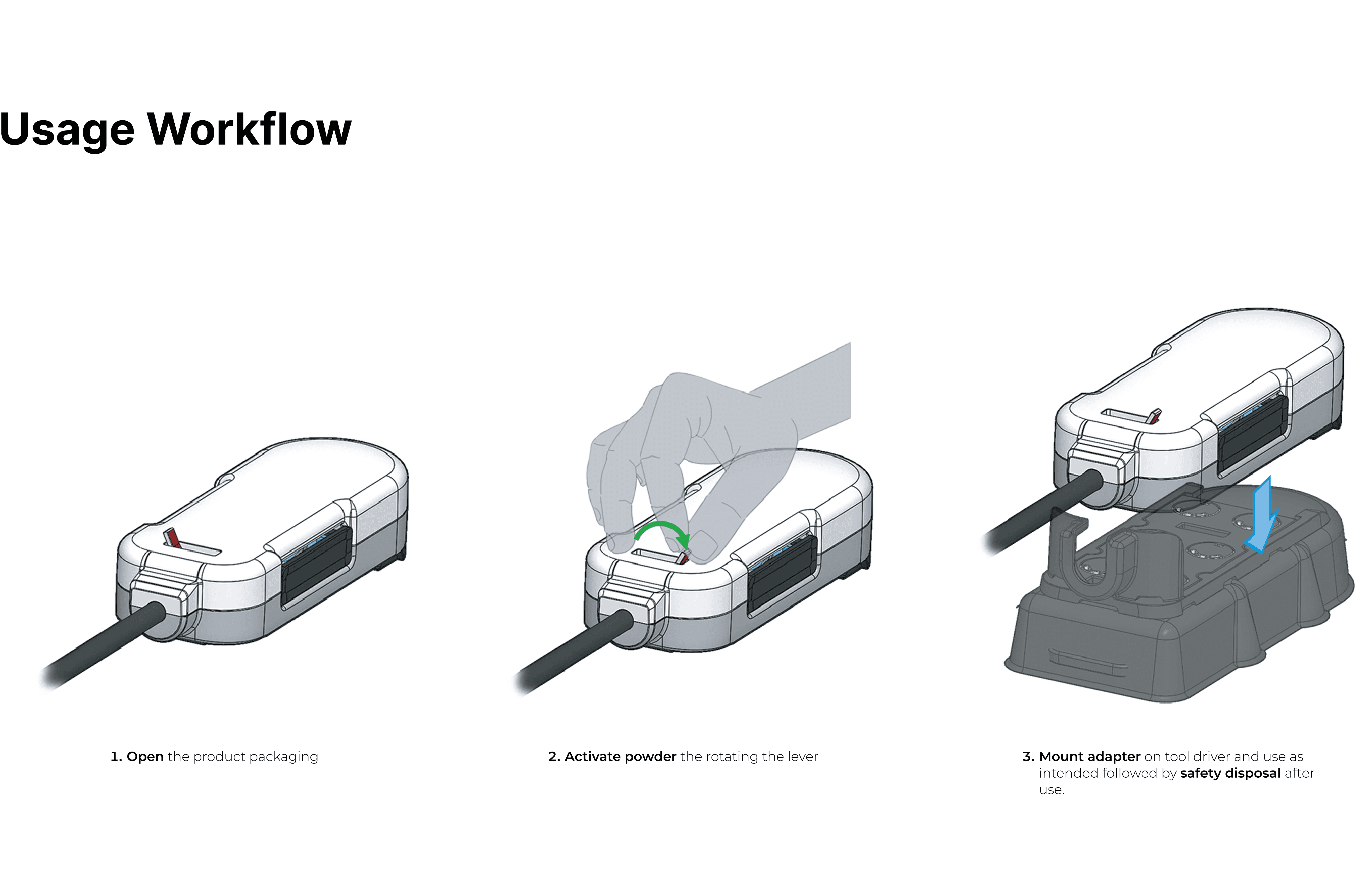
Activate powder the rotating the lever
Mount adapter on tool driver and use as intended followed by safety disposal after use.
Concept 1a
Device is activated by rotating the nozzle head lever in opposite direction, before attaching it to tool driver. the mechanism uses a rotatory crank system to activate the bellow, enabling back and forth movement to push air.
Side Section View showcasing how air is pumped to carry powder contents via nozzle
Front View indicating how nozzle is rotated to activate powder vial for dispensing
Robot will rotate the puck controlling the crank driver mechanism to provide to and fro movement, pushing the bellow and dispensing air.
Concept 2
The robot rotates the puck, driving a helical gear that spins the axle at 2500–3300 RPM—generating a gust of air through the chamber to propel surgical particles out of the delivery tube.
Side Section View indicates how air will be pumped to carry powder contents via nozzle
Eductor Cross Section pneumatic conveying using eductor to create suction, with air flow through middle of chamber
Concept 3
The robot will rotate the puck controlling crank driver to provide to and fro movement, pushing the piston further inwards, with the pressure forcing the powder outwards.
Side Section View indicates how powder will be pumped ut via piston compression through nozzle
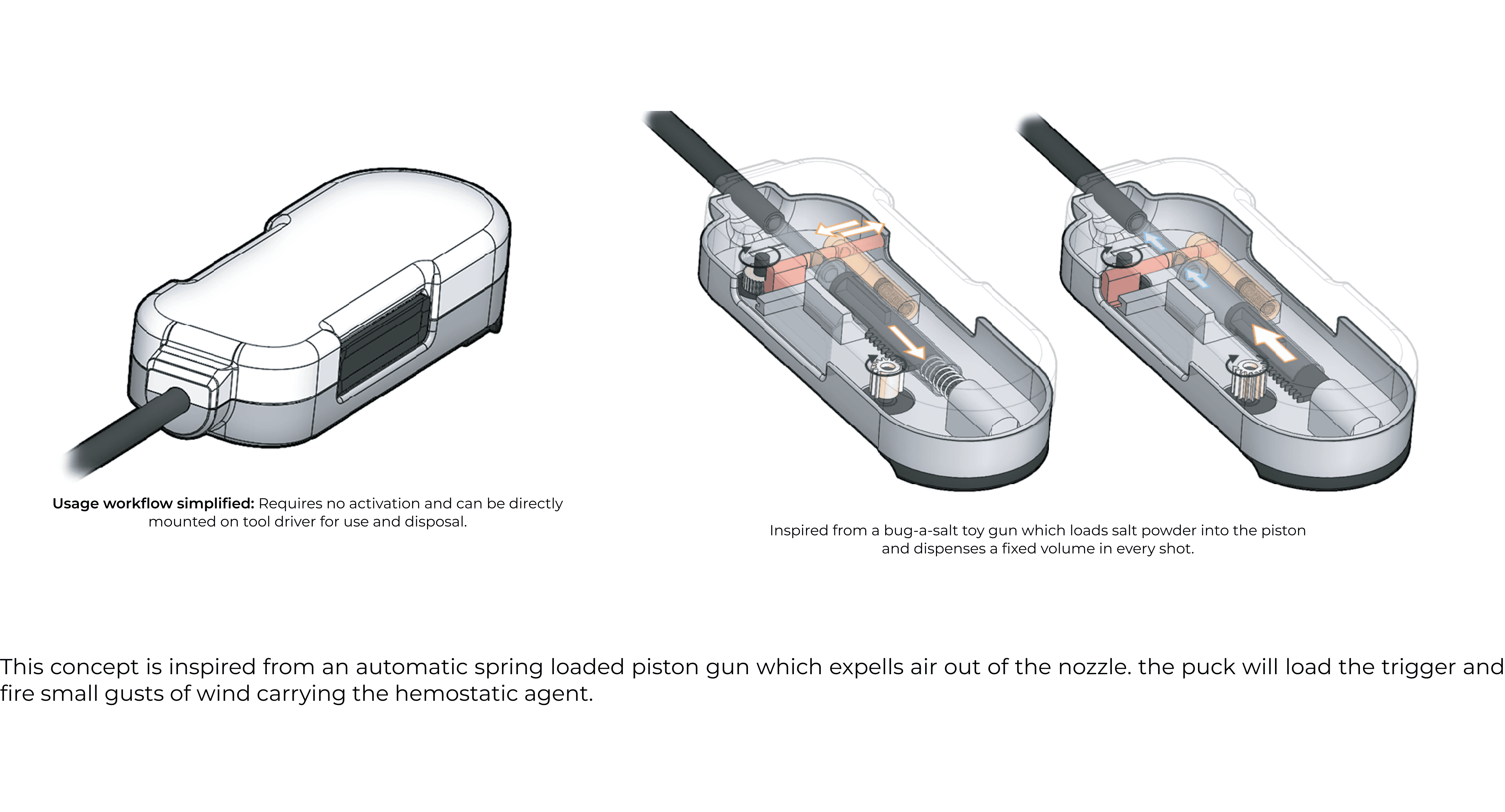
Usage workflow simplified: Requires no activation and can be directly mounted on tool driver for use and disposal.
Inspired from a bug-a-salt toy gun which loads salt powder into the piston and dispenses a fixed volume in every shot.
Concept 4
Concept is inspired from an automatic spring loaded piston gun which expells air out of the nozzle. the puck will load the trigger and fire small gusts of wind carrying the hemostatic agent.
Concept Comparison Matrix
Based on evaluation, we went ahead with plunger compression mechanism for mockup prototyping.
Mockups shared with customer for usability testing
Robotic Hemostatic Powder Dispenser
This project involves the development of a compact mechanical adapter that integrates with the Tool Driver robotic arm to precisely dispense Surgicel Powder—a surgical hemostatic agent made from oxidized regenerated cellulose (ORC). The adapter aims to deliver the powder directly onto bleeding sites to assist in controlling capillary, venous, and small arterial hemorrhages, particularly in situations where conventional methods such as ligation are impractical or ineffective. Surgicel Powder is ready to use out of the package, functions effectively at room temperature, and has been demonstrated to sustain hemostasis even under irrigation. By enabling controlled, targeted delivery of the powder, the adapter enhances the efficiency and safety of robotic surgical procedures.
Contribution
Project Lead
Concept Development
Industrial Design
Mechanical Design
Mockup POC
Concept 1b
Shifting from crank rotation to traditional rack and pinion mechanism. Considered more intuitive to mimic bellow compression from the trigger on the console. Also it give more control over the amount of compression, powder expressed with respect to degree of compression.
Interface at the console end used to control the surgical arms reveals a pinch grip mimicking a trigger